Kitchen remediation for German cockroaches requires targeted precision rather than broad-spectrum repellent sprays. Unlike outdoor peri-domestic species such as the American cockroach or smokybrown cockroach, the…
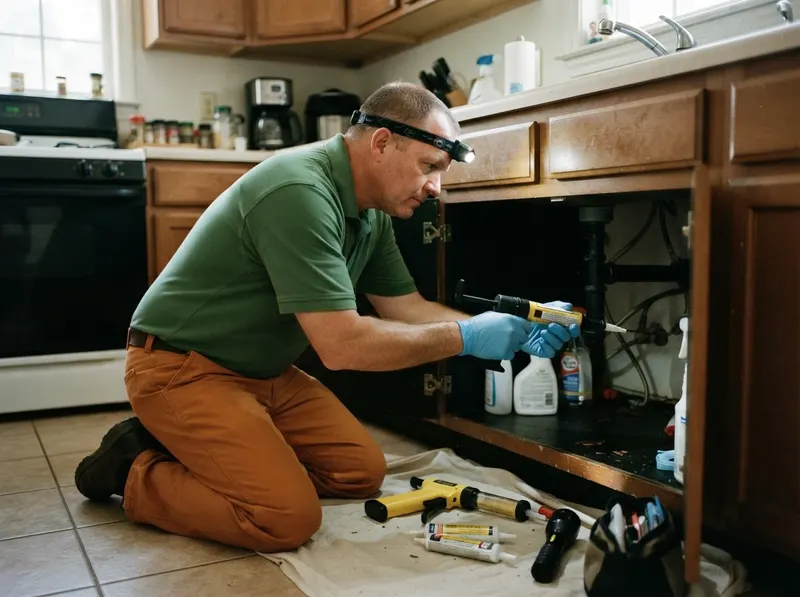
Kitchen remediation for German cockroaches requires targeted precision rather than broad-spectrum repellent sprays. Unlike outdoor peri-domestic species such as the American cockroach or smokybrown cockroach, the University of Florida Entomology department notes that Blattella germanica relies entirely on indoor human structures. Kitchen aggregations center around warm electrical compressors, under-counter dishwashers, and moisture-rich plumbing entries. Standard contact sprays often cause budding, where pregnant females drop egg capsules (oothecae) prematurely and scatter deep into drywall cavities. FalconVale Insect Services applies focused non-repellent baits paired with EPA-registered insect growth regulators (IGRs) like pyriproxyfen to stop juvenile development and preserve home sanitation.
In historic neighborhoods such as South of Broad, Harleston Village, and Radcliffeborough, structural settling creates deep micro-crevices behind heart-pine tongue-and-groove boards, plaster lath, and custom beadboard panels. These architectural characteristics allow breeding colonies to anchor near heat-generating appliances while avoiding surface contact. Modern kitchens across West Ashley, James Island, and Daniel Island encounter similar harborage dynamics behind built-in microwaves and modern stone backsplashes. Remediating these areas requires direct mechanical flushing using targeted vacuum units equipped with OSHA compliant filtration systems, followed by micro-dot placements of low-toxicity baits conforming to CDC guidelines for domestic indoor allergen reduction.
Humidity management plays an indispensable role along coastal South Carolina marshlands, including Cainhoy Peninsula and Wagener Terrace near the Ashley River. Excess ambient moisture allows German cockroaches to sustain high reproductive rates, where an egg case containing up to 48 nymphs hatches every 28 days. Guidance from Clemson University Cooperative Extension indicates that roach populations expand exponentially when indoor relative humidity consistently exceeds 60 percent. Remediation protocols include sealing voids with silicone sealants along cabinet trim and coordinating pipe flange insulation to deny harborage points adjacent to supply lines.
Food preparation surfaces demand compliant application protocols. Bait placements adhere strictly to specifications recognized by the National Pest Management Association and standards maintained by SC DHEC for non-contamination of domestic cooking spaces. Chemical applications are confined to unexposed structural hinges, appliance motors, and hollow wall voids, keeping food preparation zones untainted. The process follows three plain steps: 1. Complete appliance pulling and perimeter drawer void clearing. 2. Vacuum extraction of live adults and egg capsules followed by bait matrix injection into harborages. 3. Placement of pheromone monitoring boards to track population decline ahead of the day-14 developmental check.
Every job gets a firm, written price after a free on-site visit.
Tell us about your german cockroach kitchen remediation job in Charleston and we'll send a clear, written quote, usually the same day.
 FalconVale Insect Services