Charleston's extended coastal growing season and maritime humidity sustain severe parasite activity from late March through November. Outdoor Flea and Tick Yard Barrier Defense establishes a continuous protective…
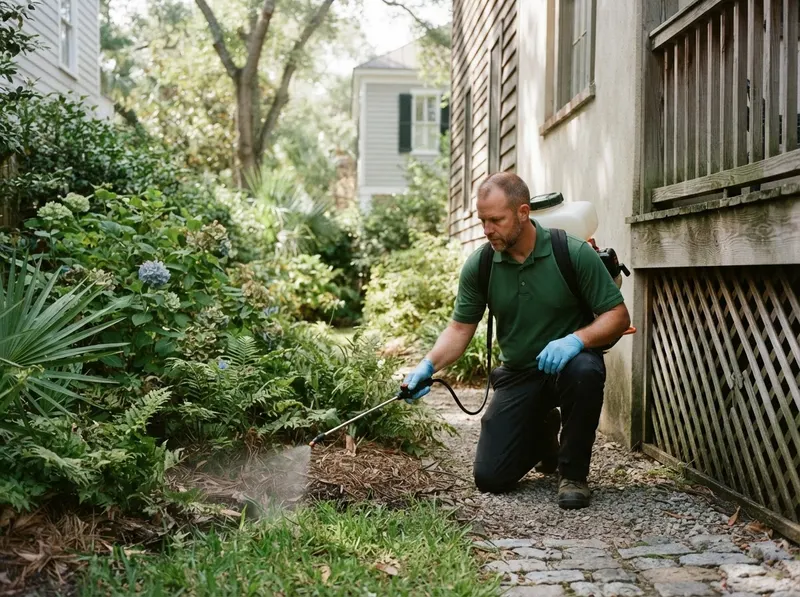
Charleston's extended coastal growing season and maritime humidity sustain severe parasite activity from late March through November. Outdoor Flea and Tick Yard Barrier Defense establishes a continuous protective boundary using synthetic pyrethroids or insect growth regulators, verified through standards established by the U.S. Environmental Protection Agency. The barrier coats the critical interface between wild marsh margins and manicured grass, reducing exposure for households and pets without locking homeowners into arbitrary annual multi-service contracts.
Treatment zones target moisture-retaining substrates across low-elevation neighborhoods like Wagener Terrace, James Island, and West Ashley, where damp live oak shade prolongs egg viability. Technicians apply liquid barriers using calibrated backpack equipment along fence lines, under deck foundations, and through dense plantings of sweetgrass, azaleas, and palmetto underbrush. Guidance from the Clemson University Cooperative Extension outlines precise droplet sizing to penetrate thick ground cover where blacklegged ticks host on deer and rodents. For larger properties on Daniel Island and the Cainhoy Peninsula, granular formulations settle beneath pine straw mulch, activating with baseline soil moisture while minimizing drift toward sensitive coastal waterways monitored by the South Carolina Department of Health and Environmental Control.
Historic downtown courtyards in South of Broad, Harleston Village, and Radcliffeborough present confined stone, brick, and micro-turf challenges. In these high-density urban corridors near historic landmarks like The Battery and White Point Garden, high brick perimeter walls retain radiant heat and humidity, creating sheltered flea harborage. Targeted treatments comply with application thresholds recorded by the National Pesticide Information Center to control active infestations without leaving visible surface residues on historic stone pavers. Technicians isolate applications away from open cisterns or ornamental fish basins, adhering to environmental safety guidance outlined by the U.S. Fish and Wildlife Service.
Property owners choosing between localized yard treatments and whole-property perimeter defense must weigh localized spot applications against whole-yard residual coverage. A spot treatment covers isolated pet bedding or small turf patches, whereas a full barrier seals the 10-foot perimeter around living structures, property fence borders, and outbuildings. Yard barriers require ground vegetation to dry for approximately 60 to 90 minutes before family members and pets re-enter treated turf, consistent with vector management benchmarks documented by the Centers for Disease Control and Prevention and the National Pest Management Association. Outdoor barrier treatments target perimeter turf and shrub zones, meaning active indoor flea infestations require a coordinated interior approach rather than outdoor barrier chemical alone.
Every job gets a firm, written price after a free on-site visit.
Tell us about your outdoor flea and tick yard barrier defense job in Charleston and we'll send a clear, written quote, usually the same day.
 FalconVale Insect Services