Powderpost beetle wood-boring insect remediation addresses severe structural threats across Lowcountry architectural styles, from post-and-beam foundations in historic South of Broad and Harleston Village to raised…
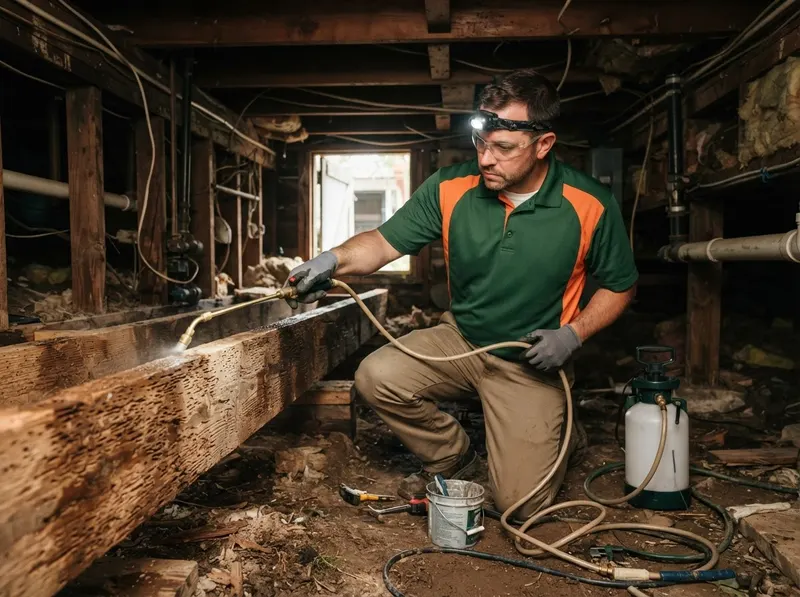
Powderpost beetle wood-boring insect remediation addresses severe structural threats across Lowcountry architectural styles, from post-and-beam foundations in historic South of Broad and Harleston Village to raised foundations throughout Wagener Terrace and Radcliffeborough. Larval emergence creates round exit holes between 1/32 and 1/8 inch wide, discharging flour-fine wood powder that indicates active digestion inside damp structural members. The standard protocol utilizes water-soluble disodium octaborate tetrahydrate (EPA pesticide registration standards) applied directly to bare wood framing, penetrating deep into sapwood capillary channels to intercept larvae during nutrient ingestion. Historic structures, including properties cataloged by the National Park Service Preservation Briefs, require specialized non-staining surface saturations rather than destructive chemical drilling.
Selecting localized borate spray saturation fits structural framing with wood moisture content elevated between 14% and 28%. When structural timbers stay dry below 12% moisture content, beetle larvae cannot sustain metabolic activity, meaning environmental moisture remediation functions as the permanent trade-off to chemical retreatments. Soil dampness adjacent to salt marshes in West Ashley, Daniel Island, and James Island drives persistent humidity upward into subflooring assemblies. Crawlspaces along coastal drainages and tidal waterways tracked by the USGS National Water Information System require targeted wood surface remediation coupled with ground moisture barriers conforming to ASTM E1745 vapor retarder standards to eliminate larval re-infestation cycles permanently.
Structural interventions follow strict moisture mapping protocols established by the USDA Forest Products Laboratory. Remediating powderpost beetles requires identifying whether an infestation originates from True Powderpost Beetles (Lyctidae), which infest large-pored hardwoods, or Deathwatch Beetles (Anobiidae), which thrive in damp softwoods across coastal Cainhoy Peninsula crawlspaces. Remediation steps include: 1. Mapping timber moisture gradients with calibrated pin-probes. 2. Vacuuming active wood frass beneath joists to establish a physical monitoring baseline. 3. Applying dual-coat penetrative borate solutions directly to unsealed joists and subfloors. 4. Regulating ambient foundation air according to ASHRAE residential moisture management guidelines. 5. Installing continuous crawlspace ground vapor liners under guidelines provided by the Building Science Corporation. Ambient air conditions regulated in accordance with the U.S. Department of Energy Crawlspace Guidelines stabilize framing and protect historic investments across Charleston County.
Every job gets a firm, written price after a free on-site visit.
Tell us about your powderpost beetle wood-boring insect remediation job in Charleston and we'll send a clear, written quote, usually the same day.
 FalconVale Insect Services