American cockroaches thrive in the sub-tropical maritime conditions documented by the National Weather Service Charleston , where relative humidity levels routinely sustain outdoor populations year-round. These large…
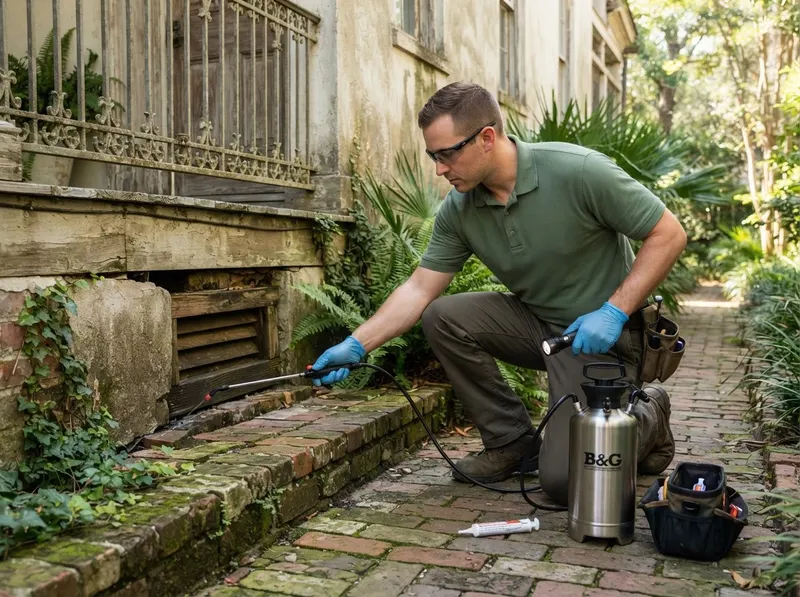
American cockroaches thrive in the sub-tropical maritime conditions documented by the National Weather Service Charleston, where relative humidity levels routinely sustain outdoor populations year-round. These large insects, measuring between 1.5 and 2.1 inches long, migrate inward when ambient soil saturates or summer heat spikes. Moisture-heavy crawlspaces, hollow wall spaces, and historic brick footings in neighborhoods like South of Broad, Harleston Village, and Radcliffeborough offer dark refuge adjacent to high-canopy trees. Eradication focuses on severing nesting sites from interior entry routes rather than relying on superficial cosmetic baseboard spraying, following integrated guidelines established by the Clemson University Cooperative Extension Home & Garden Information Center.
Treatment selection balances the speed of interior knockdowns against persistent outdoor perimeter pressures. Exterior-only barrier treatments suit homes with intact masonry foundations, zero crawlspace access, and single outdoor sightings. However, when occupants observe roaches emerging around baseboards, plumbing chases, or ceiling vents, a full interior and substructure protocol is required. Interior void treatments apply micro-encapsulated formulations adhering to standards outlined by the United States Environmental Protection Agency. The direct trade-off involves immediate structural accessibility: complete crawlspace dusting requires clearing mechanical access paths and managing elevated humidity, which occasionally necessitates independent dehumidification alongside insecticide applications monitored through CDC sanitation protocols.
Residential architecture heavily influences infestation mechanics across Charleston County. Slab-on-grade homes in West Ashley, Daniel Island, and the Cainhoy Peninsula frequently experience roofline intrusions where overhanging live oaks drop decaying organic debris directly onto shingles, governed under forestry practices from the South Carolina Forestry Commission. Conversely, pier-and-beam properties throughout Wagener Terrace and James Island demand intensive ground-level vapor barrier inspections consistent with the U.S. Department of Housing and Urban Development healthy housing standards. FalconVale Insect Services addresses these localized pressure dynamics using non-staining micro-emulsions and specialized targeted insect growth regulators recognized by the Entomological Society of America, preserving indoor living air quality in alignment with Occupational Safety and Health Administration residential criteria while systematically dismantling breeding populations.
Remediation proceeds in three systematic phases. First, technicians map exterior perimeter conduits, air vents, plumbing penetrations, and canopy touchpoints. Second, teams inject targeted micro-dusts into unsealed pipe chases and mechanical chases following baseline structural safety mandates from the International Code Council. Third, technicians lay down an exterior botanical or synthetic buffer around exterior foundations, window lintels, and crawlspace vents, complying with strict chemical-application restrictions registered with the Clemson University Department of Pesticide Regulation. For straightforward single-family homes, service requires approximately 60 to 90 minutes. Homeowners can reach dispatch at (843) 268-6980 to confirm an on-site visit.
Every job gets a firm, written price after a free on-site visit.
Tell us about your palmetto bug and american cockroach eradication job in Charleston and we'll send a clear, written quote, usually the same day.
 FalconVale Insect Services